Monday, March 28, 2016

About exposition ‘Eames & Hollywood’, again.

Despite the fact that Charles and Ray Eames practiced photography throughout their lives, the pictures they took have always been stuck in the shadow of the duo’s much-celebrated furniture, architecture and film projects. Determined to bring these photographs into the spotlight, independent curator Alexandra Midal took a trip to LA to sift through the Eames’ photography archive – a vast collection that totals 750,000 slides. Following her research, in 2013 she put together an exhibition in Milan titled ‘Re-Think the Eames’ that showcased 700 of their previously unseen photographs.
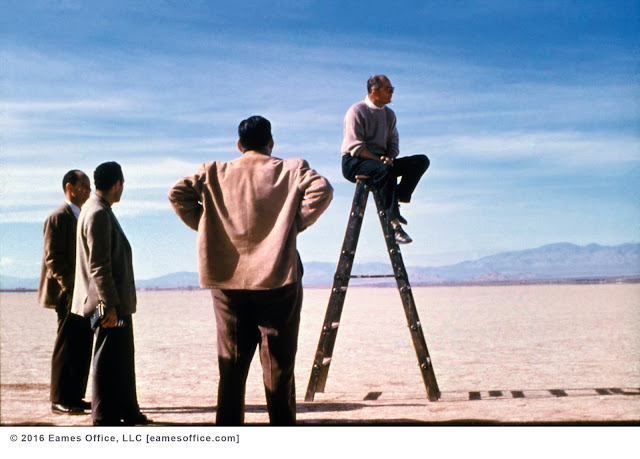
Now, three years on, Midal is revisiting the photographs, this time focusing upon a particular series titled Movie Sets that Charles Eames placed into a montage sequence for a lecture in 1971. The photographs were taken between 1951 and 1970 on the film sets of Charles’ good friend, director Billy Wilder. Bonding over their mutual love of contemporary design, the Eames and the Wilders became firm friends early on. ‘You don’t go to watch Billy shoot to learn how make a picture,’ Eames once said, ‘but to learn how to write an editorial, how to make a chair, how to make a piece of furniture.’
Now, all 240 of the previously unknown and unpublished Movie Sets photographs are being presented in a new show called ‘Eames & Hollywood’ that opens today at the Art & Design Atomium Museum in Brussels – the first temporary show that has ever been hosted at the venue. Curated by Midal with the support of the Eames Foundation, the show provides a glimpse into the world of the Eames and their own very unique way of looking at the world.
From technicians clambering over scaffolds to lighting rigs and cameras, as well as the odd glimpse of a Hollywood star, the photographs are displayed backlit across two long walls, supported by a dramatic timber scenography-inspired set designed by Adrien Rovero.
‘What matters so much for the Eames was not the actresses or actors or the stars. Absolutely not,’ says Midal in reference to the exhibition’s set design. ‘What matters to them is the technicians, the extras, the make-up artist, the machinery, the different apparatus; it’s not really the technique but the way the cinema is constructed.’
‘As kids we would see these slideshows in the office all the time and we knew they were special,’ recalls Eames Demetrios, Ray and Charles’ grandson and director of the Eames office. 'What’s so compelling about them is that although they’re nostalgic, they’re actually very contemporary in form and in the way you experience them. So to me it was thrilling to see the exhibition come together and to begin the process of getting them appreciated.


Courtesy wallpaper.com


Monday, March 21, 2016

Eames & Hollywood: a temporary show at Brussels

For his first temporary show, the ADAM, Art & Design Atomium Museum Brussels (from March 10), is presenting an unknown and stunning collection of photographic works by Charles and Ray Eames: their photographic opera, amounting to more than 750,000 images is an exceptional, yet almost unknown, work of art.
"Movie-Set" is the name of a series of 233 pictures that Charles Eames took during years on the film sets and the natural settings chosen by his friend, the director Billy Wilder ("Some Like it Hot", "Seven Years Itch", …) for his own movies. Armed with his trusty camera, Charles was continuously taking photographs of very high pictorial quality. The photos explores the backstage, movie-sets, extras, cameraman, make-up artists, etc. of Hollywood productions. In some photos, you will recognize Audrey Hepburn and Humphrey Bogart in Sabrina, or young Kirk Douglas in "Ace in the Hole", Wilder's own favorite movie.
In the work of the Eames, photography is an art in its own right. Above all, for the Eames, life, cinema and design conjoins in photography.


Ph. Courtesy: eamesoffice.com


Monday, March 14, 2016

RayE (a tribute to Ray Eames) transforming shipping containers into experiential marketing events


The things veteran Chicago AD man Otis Gibson can tell you about shipping containers. Yes, Gibson and his boutique shop Gertrude Inc. are very into the humble shipping container and how it can be transformed into something Gibson is now catchily calling "branded architecture."
Shipping Containers are at the center of a new division at Gibson's boutique ad agency Gertrude Inc. called RAYE — a named derived from Ray Eames, part of the famed husband and wife design team Ray and Charles Eames. In an interview Gibson said he decided on the name RAYE to pay tribute to his favorite designer Ray Eames.
The launch of the new unit at Gertrude Inc., which is now in its 11th year in Chicago, came, Gibson said, after his firm got more and more requests from clients to develop experiential events. "Clients increasingly are looking beyond traditional television and print ads," said Gibson. So Gibson is doing a lot of experiential stuff with what is rapidly becoming his trademark, the shipping container.
Now Gibson may very well be the only Chicago ad agency that can say it specializes in premium-branded shipping container design, modification and activation.
One of RAYE's first projects was for the spirits behemoth Diageo's line of Studebaker premixed cocktails. Gibson and his RAYE team took a large 20-foot shipping container and transformed it into a custom-designed modern speakeasy with a burnt cedar-clad exterior, a wrap-around deck, video and sound system and a dry bar — all of it growing from a humble shipping container.
But if you weren't one of those invited to enter the exclusive Studebaker speakeasy, you can still see how much Gibson likes shipping containers at the Gertrude Inc offices at 2150 S. Canalport in Chicago, where Gibson has cleverly integrated a shipping container into the office entrance.

Read all at: www.bizjournals.com/chicago/news/2016/03/01/gertrude-inc-transforming-shipping-containers-into.html

Monday, March 07, 2016

News: A Virtual Look Into Eames and Saarinen's Case Study House #9, The Entenza House

ArchDaily and Archilogic contributor Christa Gerbert shares an in-depth, virtual look inside the Entenza House, a steel-framed home designed by Charles Eames and Eero Saarinen.
Conceived as part of The Case Study Program initiated by John Entenza in 1945, the model offered the public an example of modern housing at a low cost. It is sited a short distance away from the Charles and Ray Eames’ house, which was also constructed as part of the program.
The Entenza House was built in 1949 almost exactly the way it was published in Arts and Architecture, as a rigorous steel and glass construction with an open and adaptable space, which could be modified depending on the number of family members and guests. The architects placed four columns in the center of the structure with the goal of creating a spacious interior with as little obstruction as possible. In keeping with this principle, the communal area of the house, which was 11 meters long, could be divided into different relaxation, dining and meeting areas. The floor in the living room had different levels, which created steps that could be used as informal seats.


Monday, February 29, 2016

The Maturity of Creatures of the Wind Includes an Eames Reference

Scene setting: Creatures of the Wind’s graphic, mid-century-inspired collection found the perfect home within the sumptuous Masonic Hall of the Grand Lodge of Masons New York. Set against the hall’s crimson coloured carpet and gilded columns, the label’s herringbone gilets, boldly striped coats and dresses, and clingy ribbed knits took on a lady-like softness within their elongated silhouettes.

Sound bite: Singling out the work of Charles and Ray Eames, Carl Aubock and Ikko Tanaka as inspiration, Creatures of the Wind co-founder Chris Peters explained, ‘There’s always a stillness and a softness to all of their respective work, but there’s also this really nice energy and that was what we tried to do – making these quieter moments that had these references to natural materials. There is such a functionality to their work and we wanted to have things feel really considered.’

Finishing touches: Shoes were a strong suit this season. Although options ranged from mid-height heels decorated with horn buckles to ponyskin ankle boots hand-painted with a delicate star print, it was a series of wearable calfskin loafers boasting contrasting stitching and carved wooden heels that truly took the cake.

Read more at http://www.wallpaper.com/fashion/fashionweeks/womenswear-aw-2016/new-york/creatures-of-the-wind-aw-2016#1ucQAIQkoOplSs61.99


Ph. courtesy Wallpaper.com and Getty Images


Monday, February 22, 2016

Modern Pastoral: Bring the tranquility of nature into your home, by Niki Brantmark

Discover contemporary interiors inspired by natural landscapes. Modern pastoral interiors are about embracing the pared-back lifestyle of living in the country, taking nature as the main point of inspiration. Use colors, textures, and details to create a home in which to unwind--a retreat from the rest of the world. 
Niki Brantmark (a famous blogger, see: myscandinavianhome.com) explores various takes on this simple, informal style. 
In chapter 1, "Forest", the interiors are filled with exposed wood throughout, combined with traditional patterns and features, such as log burners and woven rugs. 
Chapter 2 "Graphical", explores a look that is striking, reminiscent of weather-beaten landscapes: think whitewashed ceilings, rugged stone surfaces, and striking black features, softened by cozy soft furnishings and fresh plants and flowers--while Homestead style in chapter 3 introduces warmer hues, featuring painted wood and creamy, light browns in textiles, furniture, and collectibles. 
The final chapter, "Waterside", brings to mind calm lakes and babbling streams, where rooms are filled with light, and gentle blue and gray shades pervade. Photographed in homes across Scandinavia and the United States, all evoke an ideal, rural life, adapted to modern living.

Availabe at: http://www.amazon.com/Modern-Pastoral-Bring-tranquility-nature/dp/1782493085


Monday, February 15, 2016

Five things that Charles & Ray teach us about play (5/5)

5) PLAY CAN LEAD TO INNOVATION
Charles often implored us to “Innovate as a last resort.” It may be true that “More horrors are done in the name of innovation than any other,” but focused play can lead to innovations that positively impact society as a whole.

In 1957, the Eameses accepted a commission to help the Aluminum Company of America (Alcoa) with a new marketing initiative. They decided to create what they called the Solar Do Nothing Machine—a deceptive name, given that this colorful, whimsical kinetic toy was powered by solar cells. The husband-and-wife team tried making the machine with everything from steam and flash boilers to turbines and air motors before determining what would work best.

Charles noted that, “A demonstration of solar energy as a practical source of power appeared to be a not uninteresting way of promoting resource conservation.”

And he was right. Through play, Charles and Ray engineered something remarkably forward-thinking for their time—something that we continue to apply to our world today.


Monday, February 08, 2016

Five things that Charles & Ray teach us about play (4/5)

4) PLAY IS FOUND IN THE CONNECTIONS
Charles said, “Eventually everything connects–people, ideas, objects. The quality of the connections is the key to quality per se.”

Charles and Ray knew that learning and play often intersect. Through their Eames House of Cards, we gain associations from various arrangements; we see that building something is an ongoing and often collaborative process; and we begin to appreciate the “uncommon beauty of common things.” In creating the Eames House of Cards, Charles explained:

…we began to take photographs of objects which we, ourselves, cared for very much. And soon, the objects began to build up a pattern. And as Ray put it, before we get through, we’ll have a set of cards that will be great fun for anyone from eight to 115 years old. And they include things like spools of thread, a metronome, and a bunch of old buttons and things.

Now this seems innocuous enough, in itself, but the fact is again you have relationships. I mean, whether it’s a child or an adult looking at a series of these images in relationship to each other, why the meanings change.


Via hermanmiller.com 


Monday, February 01, 2016

Five things that Charles & Ray teach us about play (3/5)

3) IT PAYS TO PRACTICE “PREPARED SPONTANEITY”
Charles and Ray had an immense love for the circus. One might think of the circus as the ultimate space for play, but what most intrigued the Eameses about it was the prepared spontaneity of the show. They knew that it takes extreme rigor and diligence to put on an engaging circus act. For this kind of play to be successful and look effortless, everyone involved must be nimble—and that only comes with hard work. In a speech Charles presented to The American Academy of Arts and Sciences, he said:

In the actions of circus people waiting or rehearsing or preparing to perform, there is a quality of beauty, which comes from appropriateness to a given situation. There is a recognized mission for everyone involved. In a crisis there can be no question as to what needs to be done. The circus may look like the epitome of pleasure, but the person flying on a high wire, or executing a balancing act, or being shot from a cannon must take his pleasure very, very seriously.

Charles and Ray applied these ideas to their own work, and they believed that everyone else could too.


Via hermanmiller.com