Monday, February 20, 2017

Eames Lecture in Genk, Belgium

Today, in conjunction with the exhibition The World of Charles and Ray Eames, join C-mine for a lecture on the work and legacy of Charles and Ray Eames by Eames Office director, Eames Demetrios.

Eames Demetrios is best known for his work as director of the Eames Office, but he is also the grandson of Charles Eames. He is striving to introduce a younger generation to the legacy of Charles and Ray Eames and ensure that the design duo’s unique work is preserved and shared worldwide. At C-mine, he will speak about the mission of the Eames Office and the many ways that Charles and Ray’s research and projects have left a lasting mark on the design world.
Lecture in collaboration with Architectuurwijzer.

Event Details
Monday, February 20, 2017
8:15 pm
Great hall C-mine Cultural Centre
Language: English

Exhibition & Lecture: € 17 general / € 12 under 26 years
Exhibition only: € 12 general / € 7 under 26 year
Tickets available at C-mine’s welcome desk or online.


Thanks for sharing eamesoffice.com + C-mine

Eames Demetrios, Director of the Eames Office

Monday, February 13, 2017

New Development Threatens the Original Eames-Designed Herman Miller Showroom

The 1949 famous building could be surrounded by a mixed-use hotel, retail, and residential tower.
Developer Jason Illoulian’s Faring Capital (which also owns Norms La Cienega and the Factory nightclub on Robertson) owns the showroom, as well as the adjacent 1931 art deco building (formerly Poliform), former Tommy Hilfiger retail store, and 4-story apartment house. He has plans to use the space to build a mixed-use development. The multi-story project includes a hotel, retail, and approximately 80 residential units, according to West Hollywood associate planner Adrian Gallo. It would only partially preserve the Eames showroom.
“They’re keeping the first half of it intact,” Gallo said of the showroom. “And the back half of it would be the new building.” Adrian Scott Fine, preservation director of the Los Angeles Conservancy, wants to see a more sensitive approach. “I understand that the intent is to preserve the front of the building,” he says. “It’s more than a facadectomy.”
The original showroom interior was modular and designed to show off furniture the way it might look in a home. Charles and Ray Eames designed covers for Arts & Architecture magazine, and their pieces were ubiquitous in the magazine’s Case Study House program.
Representatives for the developer will be sharing more plans last February 9 at a community meeting for neighbors to learn how the project will affect them. Roy Rogers Oldenkamp, president of the West Hollywood Preservation Alliance, is confident the new project will save much of the original building. Oldenkamp relayed a Faring spokesman’s message that the project will “peel back the layers of time to bring the Eames masterwork as close to the original as possible.”
It’s one thing to update the interiors of a neoclassical building when stone and stucco hide everything. Saving a glass façade requires a real master.
We wish that Charles and Ray were still around to take the job.


Thanks for sharing: Los Angeles Magazine
Photography by Julius Shulman © J. Paul Getty Trust. Getty Research Institute, Los Angeles


Herman Miller showroom designed in 1949 by Charles and Ray Eames


Monday, February 06, 2017

Eames spotting 2017: Sherlock

Martin Freeman (aka John Watson) in "The Lying Detective", Sherlock, season 4, episode 3, 2017.

Monday, January 23, 2017

How House Industries Designs Its Retrotastic Logos and Typefaces

In 2000 Andy Cruz and his coworkers at House Industries decided to create a font based on the legacy of designers Charles and Ray Eames. After immersing themselves in Eames archives at the Library of Congress and interviewing Herman Miller engineers, the type designers landed on a whimsical set of letters based on Ray’s handwriting. But when they presented it to Eames Demetrios, the famed designers’ grandson, he recoiled.
“He was very clear that we weren’t really bringing much to the table, as far as bringing some new thinking to the Eames story,” Cruz recalls. The feedback stung, but it was valuable. By that time, Cruz and the rest of House Industries had left their scrappy, upstart days behind them (the designers had recently released their wildly successful Neutra typeface, which you probably know as the Shake Shack font), but they’ve never grown allergic to criticism. In fact, if Cruz’s candid new monograph is any indication, receptivity has been essential to his type foundry’s success.
In House Industries: The Process Is the Inspiration,Cruz joins co-founders Rich Roat and Ken Barber in reflecting on a quarter century’s worth of work. But rather than publish page after page of type designs and logos, Cruz, Roat, and Barber amassed case studies for a handful of notable projects, from a logo for Hermès Japan to a set of designs based on hot-rodding. Through detailed accounts, the designers candidly explore not just their successes but their failures—what inspired them, what tripped them up, and how they arrived at a finished product.
In the case of the Eames font collection, House Industries heeded Demetrios’s advice. “He showed us how to go back and try to build something that wasn’t a regurgitation of something we’d seen before, but a tool that could point to something we love about Eames,” Cruz says. The result was a typeface that channels Eames-ian principles like elegance, sturdiness, and economy of space without parroting any Eames ephemera.
Understanding how to make vintage designs feel fresh has made House Industries popular with clients ranging from the Jimmy Kimmel Show to director JJ Abrams, a House Industries fanboy and author of the book’s introduction. But what Cruz and his colleagues took away from the Eames project is a fraction of what the designers have learned running House Industries these past 25 years. You’ll find a few choice examples of other lessons in the gallery above—and many more in the new monograph itself.

Thanks for sharing: wired.com
Ph. Carlos Alejandro / Courtesy of House Industries


Monday, January 16, 2017

These cool midcentury home and design ads are everything you'd expect

There is a impressive digital database, called AdSausage, with over 40,000 vintage advertisements just waiting for your perusal.
The searchable database has it all: from hilarious 1950s and ‘60s advertisements for dishwashers, irons, and ovens, to ‘70s magazine ads for the latest in telephone technology, which stood a far cry from, say, today’s smartphone.
We are, natch, particularly enamored of the “Design” category, which includes a groovy, full-page midcentury Herman Miller Furniture ad for Charles Eames’s Aluminum Group, and the most amazing set of ads for architectural and residential lighting. The spots aren’t just from U.S. magazines, either: In our dive into the archives, we spotted clippings from European journals, too.
The documents were digitized under the supervision of a scientist at the Brookhaven National Laboratory in Upton, New York, who, according to AdSausage, oversees the scanning of each page on the site with a “multidetector positron scanner.” This minimizes the dirt and other grime on the originals when scanned and, thus, maximizes our ability to lose hours at a time wading through glorious commercial kitsch of yore.
Take a look over at AdSausage.


Thanks AdSausage and Curved.com for sharing.


Monday, December 26, 2016

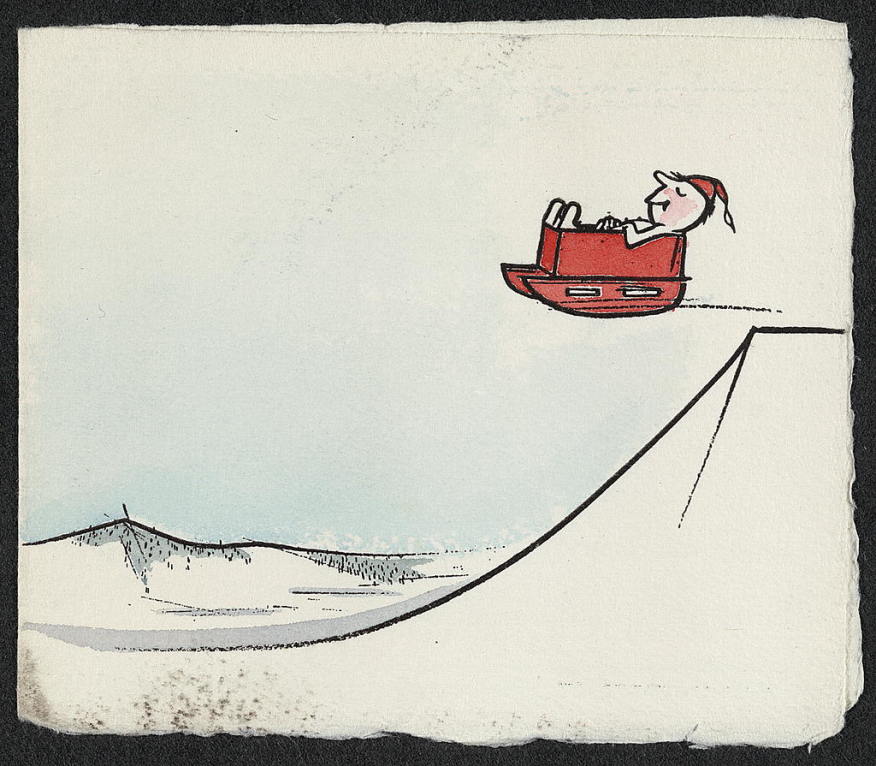
Christmas Cards sent to Charles and Ray Eames

These Christmas cards are from the Library's nearly 1,000,000-item collection of photographs drawings, films, slides and manuscripts from Charles and Ray. The Eameses saved hundreds of cards (see herefrom friends, family and colleagues -- some among the greatest artists and designers of our time. 

Harry Weese


Robert Osborn

Toshihiro Katayama

     Sister Corita Kent

Monday, December 19, 2016

Christmas Card 1942

Christmas card from Charles and Ray Eames to Harry Weese, 1942

Monday, December 12, 2016

Industrial designer recreates the Eames shell chair in wood

Tasked by Wisconsin furniture manufacturer Wooda with creating a chair, industrial designer Tucker Viemeister recreated Charles and Ray Eames 1950s Molded Fiberglass Side Chair in a log. This combination of a traditional raw material with new technology and CNC-machining challenges the notion that a design must be unique. “All designers feel challenged to create a great chair—but why? There are so many good ones already. What can the designer offer? What is new?” asked Viemeister in a statement.
When Viemeister responded to Wooda’s request for a new chair design with a photoshopped photo of a log with an Eames chair carved into it, founder Terry Sweeney was intrigued. He collected three eight-foot oak logs from a nearby forest and input the surface mesh metrics into a CNC-milling machine. The machines ground the end of the logs to a 21-inch-diameter, 17-inch-high seat using a process similar to a pencil sharpener. The rest of the log was left natural to further jar the eye as it tries to reconcile the iconic design in a wholly new medium. “The form is so engraved in our cultural memory that the slightest violation of line or curve stands out like fingernails on a chalkboard,” said Viemeister, whose clients include Corning glass, the National Zoo, Coca-Cola, Cuisinart, Apple, OXO, Toshiba, and many others. Wooda had initially reached out to the industrial designer because it wanted to connect its abundant access to raw materials, space, and technology with innovative ideas and fresh aesthetics.


Read all at archpaper.com (thanks for sharing).
Ph: courtesy Tucker Viemeister


Monday, December 05, 2016

A Lost Snippet of Eames'"Think", Found in a Home Movie Shot in 1964

Robert Anen, a second-year graduate student in New York University's Moving Image Archiving and Preservation (MIAP) MA program, made a discovery during his summer 2016 internship at Indiana University (IU) Libraries that will help the Library of Congress restore a landmark multimedia production.
"Think" (1964) by Ray and Charles Eames was shown across 22 multi-sized screens at the 1964-65 New York World’s Fair. According to the Eames' website, "visitors were lifted 53 feet" into the IBM Pavilion's Ovoid Theater to view Think, which "explored problem-solving techniques for issues both commonplace and complex."
The New York World’s Fair introduced computer technology to millions of visitors, particularly at the IBM Pavilion. Rachael Stoeltje, director of IU Libraries’ Moving Image Archive, describes what these pavilion visitors might have experienced. "Think was more than innovative, it was historic. It intermixed motion pictures and slide projections with a live emcee.”
Now, more than 50 years later, a newly discovered home movie in the Edward and Naomi Feil Collection at IU Libraries’ Moving Image Archive is helping the Library of Congress bring Think back to life.


Read all at: nytimes.com
The multi-sized screens at the 1964-65 New York World’s Fair (ph.credits: EamesOffice).