Monday, April 24, 2017

Mexican-Canadian artist Rafael Lozano-Hemmer plays with a chair of Charles and Ray

"Wavefunction" is an interactive installation by Mexican-Canadian artist Rafael Lozano-Hemmer showed at the University of Michigan Museum of Art, Ann Arbor, Michigan, United States (April 22‒July 30, 2017).
Wavefunction is a kinetic sculpture comprised of fifty to one hundred Charles and Ray Eames moulded chairs (designed in 1948) and placed in a regular array of rows, facing the entrance to the exhibition space. When someone approaches the work, a computerised surveillance system detects their presence and the closest chairs automatically begin to lift off the ground, creating the crest of a wave that then spreads over the whole room. A system of electromechanical pistons raises each chair forty centimetres from the ground. The pistons are controlled by a computer that runs the mathematics of fluid dynamics, thus making the waves interfere with each other, creating turbulence or becoming calm, just like real water.
The idea of a 'function' as a field for artistic experimentation is a motivation for this piece. Other references include: the mathematics of dynamic systems, capable of generating complex non-linear, behaviours, the materialisation of surveillance and turbulence and the anti-modular reinterpretation of the work of modern designers such as Charles and Ray Eames.

Ph. courtesy: Rafael Lozano-Hemmer


Saturday, February 25, 2017

“Saving Orphan Films”: Eames Screening at Wexner Center

Today: See the Eames film Day of the Dead and other “orphan films” at the Wexner Center for the Arts (Columbus, Ohio). Introduction by Jeff Lambert, executive director of the National Film Preservation Foundation.

Saving “Orphan” Films is part of the third-annual film festival, Cinema Revival: A Festival of Film Restoration.
Established in 1997, the National Film Preservation Foundation was formed by Congress to help save America’s film heritage. In this program, the foundation’s Jeff Lambert introduces a program of “orphan films”—works with no corporate owner or copyright holder and at greatest risk of falling through the cracks—whose preservation the NFPF is supporting. The program includes films by Charles and Ray Eames, Owen Land, and Shirley Clarke, among others. (Program approx. 90 mins., 16 & 35mm)

Event Details:
Wexner Center for the Arts (Ohio State University, Columbus)

Saturday, February 25, 2017
4:30 pm

Program Lineup:

Fifty Million Years Ago(Service film, 1925; 35mm, silent, tinted)
Preserved by the Academy Film Archive.

Faces & Fortunes(Goldsholl Design & Film Associates, 1959; 16mm, sound, color)
Print courtesy Chicago Film Archives.

Young Braves(Michael Jacobsohn, 1968, 16mm, sound, b&w)
Print courtesy New York Public Library.

A Film of Their 
1973 Spring Tour Commissioned by Christian World Liberation Front of Berkeley, CA
(Owen Land, 1974; 16mm, sound, color)
Preserved by Anthology Film Archives.

24 Frames Per Second (Shirley Clarke, 1977; 16mm, sound, color)
Print courtesy Wisconsin Center for Film and Theater Research.

Day of the Dead(Charles and Ray Eames, 1957; 35mm, sound, color)
Preserved by Library of Congress.

Multiple Sidosis(Sid Laverents, 1970; 16mm/35mm, sound, color)
Print courtesy UCLA Film & Television Archive.


Thanks for sharing: eamesoffice.com + wexarts.com + Library of Congress


Charles and Ray Eames, Day of the Dead, 1957


Monday, February 20, 2017

Eames Lecture in Genk, Belgium

Today, in conjunction with the exhibition The World of Charles and Ray Eames, join C-mine for a lecture on the work and legacy of Charles and Ray Eames by Eames Office director, Eames Demetrios.

Eames Demetrios is best known for his work as director of the Eames Office, but he is also the grandson of Charles Eames. He is striving to introduce a younger generation to the legacy of Charles and Ray Eames and ensure that the design duo’s unique work is preserved and shared worldwide. At C-mine, he will speak about the mission of the Eames Office and the many ways that Charles and Ray’s research and projects have left a lasting mark on the design world.
Lecture in collaboration with Architectuurwijzer.

Event Details
Monday, February 20, 2017
8:15 pm
Great hall C-mine Cultural Centre
Language: English

Exhibition & Lecture: € 17 general / € 12 under 26 years
Exhibition only: € 12 general / € 7 under 26 year
Tickets available at C-mine’s welcome desk or online.


Thanks for sharing eamesoffice.com + C-mine

Eames Demetrios, Director of the Eames Office

Monday, February 13, 2017

New Development Threatens the Original Eames-Designed Herman Miller Showroom

The 1949 famous building could be surrounded by a mixed-use hotel, retail, and residential tower.
Developer Jason Illoulian’s Faring Capital (which also owns Norms La Cienega and the Factory nightclub on Robertson) owns the showroom, as well as the adjacent 1931 art deco building (formerly Poliform), former Tommy Hilfiger retail store, and 4-story apartment house. He has plans to use the space to build a mixed-use development. The multi-story project includes a hotel, retail, and approximately 80 residential units, according to West Hollywood associate planner Adrian Gallo. It would only partially preserve the Eames showroom.
“They’re keeping the first half of it intact,” Gallo said of the showroom. “And the back half of it would be the new building.” Adrian Scott Fine, preservation director of the Los Angeles Conservancy, wants to see a more sensitive approach. “I understand that the intent is to preserve the front of the building,” he says. “It’s more than a facadectomy.”
The original showroom interior was modular and designed to show off furniture the way it might look in a home. Charles and Ray Eames designed covers for Arts & Architecture magazine, and their pieces were ubiquitous in the magazine’s Case Study House program.
Representatives for the developer will be sharing more plans last February 9 at a community meeting for neighbors to learn how the project will affect them. Roy Rogers Oldenkamp, president of the West Hollywood Preservation Alliance, is confident the new project will save much of the original building. Oldenkamp relayed a Faring spokesman’s message that the project will “peel back the layers of time to bring the Eames masterwork as close to the original as possible.”
It’s one thing to update the interiors of a neoclassical building when stone and stucco hide everything. Saving a glass façade requires a real master.
We wish that Charles and Ray were still around to take the job.


Thanks for sharing: Los Angeles Magazine
Photography by Julius Shulman © J. Paul Getty Trust. Getty Research Institute, Los Angeles


Herman Miller showroom designed in 1949 by Charles and Ray Eames


Monday, February 06, 2017

Eames spotting 2017: Sherlock

Martin Freeman (aka John Watson) in "The Lying Detective", Sherlock, season 4, episode 3, 2017.

Monday, January 23, 2017

How House Industries Designs Its Retrotastic Logos and Typefaces

In 2000 Andy Cruz and his coworkers at House Industries decided to create a font based on the legacy of designers Charles and Ray Eames. After immersing themselves in Eames archives at the Library of Congress and interviewing Herman Miller engineers, the type designers landed on a whimsical set of letters based on Ray’s handwriting. But when they presented it to Eames Demetrios, the famed designers’ grandson, he recoiled.
“He was very clear that we weren’t really bringing much to the table, as far as bringing some new thinking to the Eames story,” Cruz recalls. The feedback stung, but it was valuable. By that time, Cruz and the rest of House Industries had left their scrappy, upstart days behind them (the designers had recently released their wildly successful Neutra typeface, which you probably know as the Shake Shack font), but they’ve never grown allergic to criticism. In fact, if Cruz’s candid new monograph is any indication, receptivity has been essential to his type foundry’s success.
In House Industries: The Process Is the Inspiration,Cruz joins co-founders Rich Roat and Ken Barber in reflecting on a quarter century’s worth of work. But rather than publish page after page of type designs and logos, Cruz, Roat, and Barber amassed case studies for a handful of notable projects, from a logo for Hermès Japan to a set of designs based on hot-rodding. Through detailed accounts, the designers candidly explore not just their successes but their failures—what inspired them, what tripped them up, and how they arrived at a finished product.
In the case of the Eames font collection, House Industries heeded Demetrios’s advice. “He showed us how to go back and try to build something that wasn’t a regurgitation of something we’d seen before, but a tool that could point to something we love about Eames,” Cruz says. The result was a typeface that channels Eames-ian principles like elegance, sturdiness, and economy of space without parroting any Eames ephemera.
Understanding how to make vintage designs feel fresh has made House Industries popular with clients ranging from the Jimmy Kimmel Show to director JJ Abrams, a House Industries fanboy and author of the book’s introduction. But what Cruz and his colleagues took away from the Eames project is a fraction of what the designers have learned running House Industries these past 25 years. You’ll find a few choice examples of other lessons in the gallery above—and many more in the new monograph itself.

Thanks for sharing: wired.com
Ph. Carlos Alejandro / Courtesy of House Industries


Monday, January 16, 2017

These cool midcentury home and design ads are everything you'd expect

There is a impressive digital database, called AdSausage, with over 40,000 vintage advertisements just waiting for your perusal.
The searchable database has it all: from hilarious 1950s and ‘60s advertisements for dishwashers, irons, and ovens, to ‘70s magazine ads for the latest in telephone technology, which stood a far cry from, say, today’s smartphone.
We are, natch, particularly enamored of the “Design” category, which includes a groovy, full-page midcentury Herman Miller Furniture ad for Charles Eames’s Aluminum Group, and the most amazing set of ads for architectural and residential lighting. The spots aren’t just from U.S. magazines, either: In our dive into the archives, we spotted clippings from European journals, too.
The documents were digitized under the supervision of a scientist at the Brookhaven National Laboratory in Upton, New York, who, according to AdSausage, oversees the scanning of each page on the site with a “multidetector positron scanner.” This minimizes the dirt and other grime on the originals when scanned and, thus, maximizes our ability to lose hours at a time wading through glorious commercial kitsch of yore.
Take a look over at AdSausage.


Thanks AdSausage and Curved.com for sharing.


Monday, December 26, 2016

Christmas Cards sent to Charles and Ray Eames

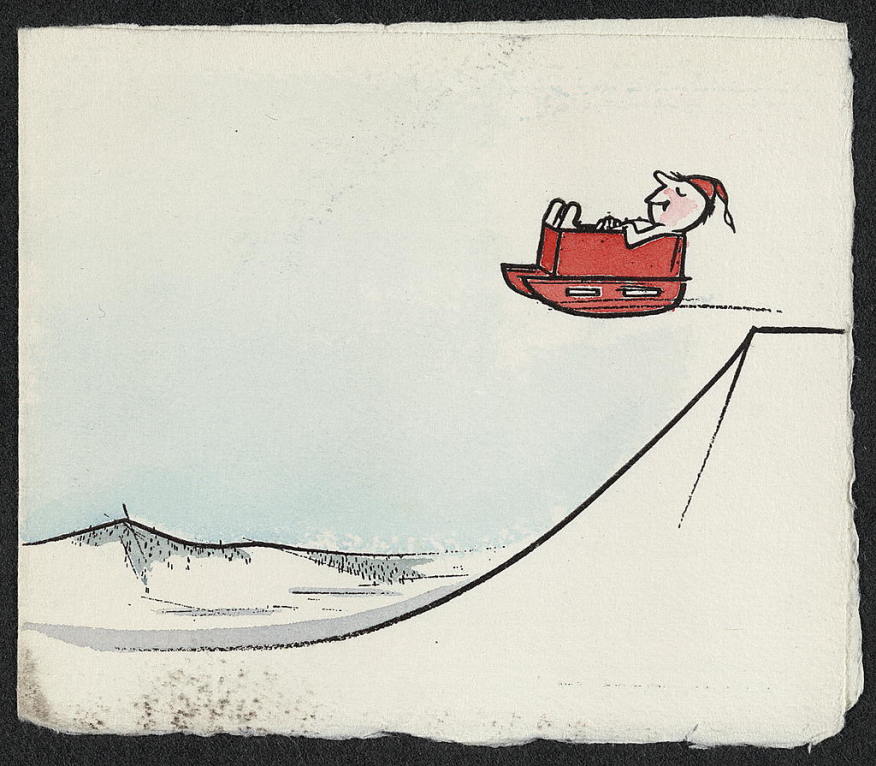
These Christmas cards are from the Library's nearly 1,000,000-item collection of photographs drawings, films, slides and manuscripts from Charles and Ray. The Eameses saved hundreds of cards (see here) from friends, family and colleagues -- some among the greatest artists and designers of our time. 

Harry Weese


Robert Osborn

Toshihiro Katayama

     Sister Corita Kent

Monday, December 19, 2016

Christmas Card 1942

Christmas card from Charles and Ray Eames to Harry Weese, 1942

Monday, December 12, 2016

Industrial designer recreates the Eames shell chair in wood

Tasked by Wisconsin furniture manufacturer Wooda with creating a chair, industrial designer Tucker Viemeister recreated Charles and Ray Eames 1950s Molded Fiberglass Side Chair in a log. This combination of a traditional raw material with new technology and CNC-machining challenges the notion that a design must be unique. “All designers feel challenged to create a great chair—but why? There are so many good ones already. What can the designer offer? What is new?” asked Viemeister in a statement.
When Viemeister responded to Wooda’s request for a new chair design with a photoshopped photo of a log with an Eames chair carved into it, founder Terry Sweeney was intrigued. He collected three eight-foot oak logs from a nearby forest and input the surface mesh metrics into a CNC-milling machine. The machines ground the end of the logs to a 21-inch-diameter, 17-inch-high seat using a process similar to a pencil sharpener. The rest of the log was left natural to further jar the eye as it tries to reconcile the iconic design in a wholly new medium. “The form is so engraved in our cultural memory that the slightest violation of line or curve stands out like fingernails on a chalkboard,” said Viemeister, whose clients include Corning glass, the National Zoo, Coca-Cola, Cuisinart, Apple, OXO, Toshiba, and many others. Wooda had initially reached out to the industrial designer because it wanted to connect its abundant access to raw materials, space, and technology with innovative ideas and fresh aesthetics.


Read all at archpaper.com (thanks for sharing).
Ph: courtesy Tucker Viemeister


Monday, December 05, 2016

A Lost Snippet of Eames'"Think", Found in a Home Movie Shot in 1964

Robert Anen, a second-year graduate student in New York University's Moving Image Archiving and Preservation (MIAP) MA program, made a discovery during his summer 2016 internship at Indiana University (IU) Libraries that will help the Library of Congress restore a landmark multimedia production.
"Think" (1964) by Ray and Charles Eames was shown across 22 multi-sized screens at the 1964-65 New York World’s Fair. According to the Eames' website, "visitors were lifted 53 feet" into the IBM Pavilion's Ovoid Theater to view Think, which "explored problem-solving techniques for issues both commonplace and complex."
The New York World’s Fair introduced computer technology to millions of visitors, particularly at the IBM Pavilion. Rachael Stoeltje, director of IU Libraries’ Moving Image Archive, describes what these pavilion visitors might have experienced. "Think was more than innovative, it was historic. It intermixed motion pictures and slide projections with a live emcee.”
Now, more than 50 years later, a newly discovered home movie in the Edward and Naomi Feil Collection at IU Libraries’ Moving Image Archive is helping the Library of Congress bring Think back to life.


Read all at: nytimes.com
The multi-sized screens at the 1964-65 New York World’s Fair (ph.credits: EamesOffice).


Monday, November 28, 2016

Herman Miller unveils its New York flagship full of midcentury silhouettes

For more than 80 years, Michigan-based manufacturer Herman Miller has been one of, if not the most prominent purveyors of modernist design. Thanks to its collaborations with the biggest designers of the time - Ray and Charles Eames, Isamu Noguchi, Alexander Girard, and the like - the company’s name has become all but synonymous with midcentury modern furniture, which has grown ever more popular since its 1950s and ’60s heyday.
Despite that, there has never been a brick-and-mortar Herman Miller store in the United States, where Eames obsessives could go to see those iconic recliners or the couple’s space-age accessories in person. The company operates a downright massive factory in Grand Rapids, Michigan, and its products are available online and in showrooms, but a true flagship store hasn’t been part of the company’s plan - until now.
Last week, Herman Miller opened in New York City its first North American retail hub in a historic Park Avenue building (251 Park Avenue South) that also houses its offices, along with Design Within Reach (which the company acquired in 2014). The bi-level space is bright, open, and inviting, with different spaces dedicated to the different functions of everyday life: sleeping, dining, working, and so on. The idea, according to Linda Choong, Herman Miller’s vice president of consumer business, is to expand the brand’s fanbase beyond its core audience.

Read all here. Thanks ny.curbed.com for sharing text and photos. 


Monday, November 21, 2016

Vitra covers Eames Lounge Chair in fabric to celebrate 60th anniversary

Swiss furniture brand Vitra is launching a limited-edition version of Charles and Ray Eames' Lounge Chair to commemorate its 60 years in production.
Vitra's update of the chair is upholstered in black twill fabric from the company's materials library instead of the traditional black leather.
The Lounge Chair Twill and matching Ottoman will be available for a limited period of three months between November 2016 and January 2017.
The company hopes the black fabric – which is complemented by warm reddish tones of palisander wood in the frame – creates a "cosy softness and inviting warmth".
While the armchair has been released with a few variations in the past, Vitra has always produced it exclusively in leather.
The newly upholstered models will also come with a corresponding label acknowledging the anniversary, along with a celebratory "60 years in Production" certificate.
Designed in 1956, the chair was originally conceived by Charles and Ray as a simple, practical and comfortable piece of furniture.

Thanks for sharing dezeen.com
Read all text here 


Monday, November 14, 2016

The top becomes an object of refined industrial production

Charles Eames would become fascinated: the top becomes an object of refined industrial production. This is the story of ForeverSpin: a Canadian independent manufacturer founded in February 2014 by Ruben Gonzalez, Viktor Grabovskyy, and Cristobal Uribe, headquartered in Toronto, Ontario. It manufactures and sells tops that are CNC-machined to a metal finish. They have funded the tops through a series of three successful Kickstartercampaigns, along with additional funding through Indiegogo. As of June 2016, they have received over $1.5 million in sales and have sold their tops to over 70 countries.
The ForeverSpin top is the only and exclusive toy manufactured by the company. It is available in 15 different finishes, and can be ordered in a bundled collection.
The tops are CNC-machined by the company at its headquarters. It goes through inspection and, if passed, is branded with a serial number and then shipped to customers. Overall, from sideways, it is 1.125 in wide.
Unlike other tops, it can spin upside-down from its spindle as well.


More info at: foreverspin.com


Monday, November 07, 2016

News: Grey Malin shoots iconic pieces by Eameses in French Polynesia

Photographer Gray Malin is reconsidering the way we traditionally experience design objects through his latest series ‘art of living’. in the pristine turquoise waters of french polynesia, malin has conceptualized an iconic selection of mid-century modern furniture set atop a reflective mirrored platform — refracting an abstract tableau of both the pieces, and the surrounding landscape.
Malin has situated archetypal mid-century modern designs by charles and ray eames atop a floating 15 foot square mirrored platform handcrafted with the help of local engineers. emphasizing the form of the furniture, ‘art of living‘ was photographed from a vantage point where the colossal mount otemanu presents a symmetrical and stunning backdrop. by situating stylized interior design elements in an unexpected outdoor setting, the series places natural and manmade beauty side-by-side, asking viewers to interpret the art of design in a new way.


Courtesy for sharing: www.designboom.com


Monday, October 31, 2016

How Should We Live: A New Exhibition Of Modernist Design 1925-1950 at MoMA

As modernist design becomes canonized, spurred by the recent enthusiasm for midcentury furniture, it’s easy to forget that an aesthetic we now take for granted was, in fact, a product of radical experimentation guided by political and philosophical thinking as much as by artistic vision.
An appropriately spare new exhibition at the Museum of Modern Art in New York called How Should We Live? puts that thinking on display, with original pieces by Charles and Ray Eames, as well as ones by figures known more for their architecture, like Le Corbusier.

More info at: www.moma.org
Thanks for sharing: www.forbes.com/


Experimental Lounge Chair, Charles and Ray Eames, 1944


Prototype for "La Chaise", Charles and Ray Eames, 1948

Monday, October 24, 2016

How a Leg Splint Shaped the Eames Chair

Before Charles and Ray Eames sculpted plywood into undulating furniture, they refined their techniques on medical devices. During World War II, the United States Navy engaged the American design duo in creating a new leg splint. The result was an object both beautiful and practical, with its biomorphic curves that delicately protected a wounded leg.
"The Body Extended: Sculpture and Prosthetics" at the Henry Moore Institute in Leeds, England, includes one of the Eames leg splints in its exploration of prosthetics and modern art. Nearby is Louise Bourgeois’s 1985 “Henriette” bronze disembodied leg sculpture, a tribute to her sister’s disability, as well Martin Boyce’s “Phantom and Fall” that uses pieces of an Eames leg splint in an Alexander Calder-like mobile. It responds to the brutality and playfulness of the 1930s and 40s, as well as the uncomfortable dissociation of form from function in our appreciation of postwar design. 


Read all at hyperallergic.com (thanks for sharing)

Installation view of ‘The Body Extended: Sculpture and Prosthetics’ (courtesy Henry Moore Institute)


Monday, October 17, 2016

Remember "India Report" in London Design Biennale

Biennales—from Venice to Chicago—have become ubiquitous events for the art and architecture worlds. And now with the inaugural London Design Biennale (LDB) at Somerset House, the rest of the design spectrum, from graphic and industrial design to furniture and virtual reality, have their own global platform.
This month’s LDB brought in installations, prototypes, and designs from 37 countries and featured 30+ talks with over 100 leading designers, design critics, and practitioners to explore the theme of ‘Utopia by Design.’ These (often whimsical) installations used design to reconcile each country’s past, present, and future, exploring issues as diverse as smart cities, the environment, global migration and the refugee crisis, postcolonial legacies, and food systems.
Below are a few of the highlights from the event, which ends today. And read our review of the Biennale here.
The London Design Biennale also marks the first time India has put forward an installation in a major international design event. India Design Forum Founder Rajshree Pathy made sure that their presence at the event would be as dramatic as the country itself.
The design of 'Chakraview’ employs the chakra system—a philosophical journey that begins with desire and consumption, moves to emotion, then speech, and finally to enlightenment—as a metaphor for India’s cultural, spiritual, social, and economic progress since independence. Six colorful silk tapestries hang above a mirrored floor, bathing attendees in the color and chaos of the space. A separate, blue, womb-like audiovisual room connects attendees to the seventh, most spiritual, chakra.
The installation also references imagery from the Eames’ 1958 India Report, produced after the three months Charles and Ray Eames spent touring the country, looking at the potential and importance of design in postcolonial India. The exhibit asserts that design is not just about developing aesthetic solutions, but indeed solutions to social problems facing India today.


Thank for sharing: metropolismag.com


Monday, October 10, 2016

Vintage Home: Using 20th-century Design in the Contemporary Home

Vintage Home, by Judith Miller, Firefly Books, 288 pages, $50.

Vintage furniture offers the best of both worlds. It brings a sense of the past and a degree of craftsmanship so often absent in today’s furnishings. A well-placed piece can become the focal point in a room and create a sense of style that you can decorate around. Vintage items can be found in a wide variety of places and it pays to know what to look for so you can spot those treasures.
Judith Miller provides a guide to 20th century designs and their origins so you can tell the difference between an Eileen Gray-designed glass and chrome table and something created by the Charles and Ray Eames Aluminum group. Filled with colour photos and detailed background information on the designers and the importance of their creations, this is a valuable resource book for anyone wanting to bring vintage style into their home.

See more at: fireflybooks.com